LORD 320/310B
Harmonization Code : 3506.91.90.99 | Prepared glues and other prepared adhesives, not elsewhere specified or included; products suitable for use as glues or adhesives, put up for retail sale as glues or adhesives, not exceeding a net weight of 1 kg ; Adhesives based on polymers of headings 3901 to 3913 or on rubber; Other ; Other
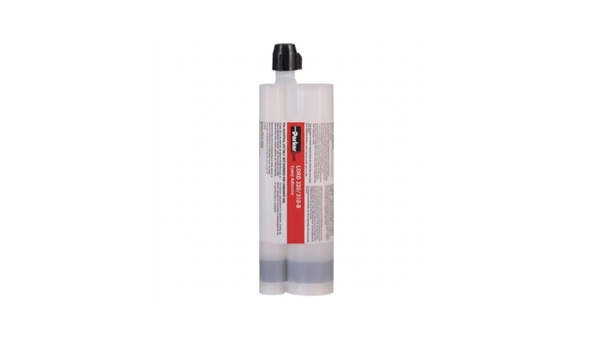
Main features
- Two-Component Epoxy for Treated Cured Rubber
- 30 to 60-Minute Working Window
- Durability Under Humidity Bonding
Product Description
LORD® 320/310-B Epoxy Adhesive is a two-component structural epoxy system formulated for bonding cured rubber treated with LORD 7701 adhesion enhancer/surface modifier. It also bonds prepared metals and a range of thermoset and thermoplastic materials. Off-white LORD 320 resin and grey LORD 310-B hardener mix 1:1 by volume or approximately 1.2:1 by weight to form a grey, 100% solids paste. The mixed adhesive provides a typical 30–60 minute working time, 6–8 hour handling-strength time, and full room-temperature cure in approximately 24 hours. Heat cure can reduce full-cure time to approximately 25 minutes at 93°C or 15 minutes at 121°C.
Key features
- Two-component structural epoxy for treated cured rubber, prepared metals and selected plastics
- Equal-volume 1:1 mix ratio for cartridge or meter/mix/dispense processing
- Room-temperature cure or accelerated heat cure
- Good impact resistance down to -40°C
- Resistance to humidity, salt spray and temperature extremes
- Solvent resistance after cure
- Post-bake resistance positioning up to 204°C under the supplier guidance
Applications
- Cured-rubber-to-metal structural bonding using LORD 7701 on the rubber surface
- Prepared metal-to-metal assemblies
- SMC and selected thermoset or thermoplastic bonding
- Glass and ceramic bonding using LORD AP-134 where required
TDS, SDS & Technical Documents
Technical Specifications
General Properties
Physical Properties
Thermal Properties
Additional Information
LORD® 320/310-B Epoxy Adhesive
A grey, equal-volume epoxy system combining off-white LORD 320 resin with grey LORD 310-B hardener. It is designed for cured rubber treated with LORD 7701 and also supports prepared metals, SMC and selected thermoset and thermoplastic materials.
High-viscosity pastes producing a grey, 100% solids adhesive
| Property | LORD 320 resin | LORD 310-B hardener | Mixed 320/310-B system |
|---|---|---|---|
| Appearance | Off-white paste | Grey paste | Grey paste; grey after cure |
| Viscosity at 25°C | 300,000–1,000,000 cP | 230,000–690,000 cP | No separate mixed-viscosity value published |
| Viscosity method | Brookfield HBF Helipath, 5 rpm | Component values only | |
| Density | 1498–1546 kg/m³ | 1198–1318 kg/m³ | Use component and ratio data for consumption calculations |
| Flash point | >93°C | >93°C | Refer to current component SDS documents |
| Mix ratio | 1:1 resin-to-hardener by volume; 1.2:1 by weight | ||
| Solids content | 100% | ||
| Working time | 0.5–1 hour | ||
| Time to handling strength | 6–8 hours | ||
Prepare each substrate according to its chemistry before applying a controlled bead
- Remove grease, oil, fingerprints, dust, mould release, rust and other contamination.
- For oxidation-free metal, use an isopropyl-alcohol wipe; abrade tarnish or oxidation where required and clean again.
- For cured rubber, apply LORD 7701 to the rubber surface and allow it to flash off before adhesive application.
- For glass and ceramic, use LORD AP-134 where required to promote adhesion.
- Mix resin and hardener until colour and consistency are uniform without entraining excessive air.
- Control batch size because exothermic heat buildup shortens working time.
- Apply in a continuous bead using cartridge, disposable cone or automatic meter/mix/dispense equipment.
- Use approximately 0.51–0.76 mm film thickness for general applications.
- Mate parts to avoid trapped air and apply only enough pressure for complete wetting without starving the joint.
Use room-temperature cure or controlled heat acceleration
Approximately 24 hours to full strength.
Approximately 2.5 hours to full cure strength.
Approximately 25 minutes to full cure strength.
Approximately 15 minutes to full cure strength.
Do not allow the bondline temperature to exceed 162°C during cure. Clean uncured excess with hot water and detergent or a compatible ketone solvent. Fully cured adhesive may be softened at approximately 204°C or above for separation and removal, subject to substrate heat tolerance.
Storage and industrial safety
Shelf life is two years from date of manufacture when LORD 320 resin and LORD 310-B hardener are stored at 16–27°C in their original unopened containers. The supplied file identified only as “rehsfil0” could not be verified as a readable, product-specific safety document. Before publication or use, obtain and review the current regional SDS for both LORD 320 resin and LORD 310-B hardener. Follow component labels for ventilation, personal protection, spill response, storage, transport, cleanup and disposal. Industrial or commercial use by trained personnel only.
Substrate- and condition-specific results with documented failure modes
Typical values below are not specification limits. The test basis used a 1:1 volumetric mix and 72-hour room-temperature cure. Metal surfaces were MEK-wiped, grit-blasted and MEK-wiped; SMC was sanded with 320-grit paper and dry-wiped; rubber was treated with LORD 7701.
| Condition | Steel lap shear | Aluminium lap shear | SMC lap shear | Natural rubber peel | SBR T-peel |
|---|---|---|---|---|---|
| Room temperature | 20.8 MPa | 15.6 MPa | 4.0 MPa | 7.8 N/mm | 4.9 N/mm |
| 82°C hot strength | 15.5 MPa | 15.3 MPa | 4.2 MPa | 11.1 N/mm | 7.0 N/mm |
| After 7 days in water at 54°C | 19.0 MPa | 19.4 MPa | 3.9 MPa | 16.2 N/mm | 4.5 N/mm |
| After 14 days salt spray | 17.7 MPa | 16.9 MPa | 3.8 MPa | 6.8 N/mm | 5.4 N/mm |
| After 14 days at 38°C/100% RH | 21.3 MPa | 17.9 MPa | 3.7 MPa | 7.3 N/mm | 5.2 N/mm |
| At -34°C | 22.2 MPa | 14.4 MPa | 4.5 MPa | 6.3 N/mm | 4.7 N/mm |
Metal film thickness: 0.254 mm. SMC: 0.762 mm. Rubber peel specimens: 0.508 mm. Failure modes include cohesive failure, fibre tear, substrate failure and adhesive failure depending on substrate and condition.
Use substrate-specific treatment and design the joint to retain adhesive in the bond area
LORD 320/310-B is particularly suited to cured-rubber bonding where LORD 7701 surface treatment can be controlled. It also supports prepared metal, SMC and selected plastic assemblies. Final qualification should address rubber compound and cure state, metal preparation, surface-treatment age, substrate fit, bondline, joint geometry, exotherm, work time, clamping, cure temperature, impact, peel, water, humidity, salt spray, post-bake exposure and failure mode.
Treat the cured rubber with LORD 7701 and prepare the metal independently before bonding.
Use the documented abrasion, cleaning and bondline controls for structural lap joints.
Use LORD AP-134 where the selected process requires a polar-substrate primer.
LORD 320/310-B technical and selection guidance
Product-specific technical data for component properties, mixing, application, cure schedules, storage and bond-performance evidence.
Open resourceGeneral selection, packaging and structural-adhesive system context.
Open resourceValidate LORD® 320/310-B for your rubber, metal or mixed-material joint
Krayden can help review LORD 7701 or AP-134 surface treatment, substrate preparation, cartridge and mixer selection, 1:1 ratio control, bondline, work time, exotherm, room-temperature or heat cure, durability testing and failure mode.