LOCTITE EA 9396.6MD
Harmonization Code : 3506.91.90.99 | Prepared glues and other prepared adhesives, not elsewhere specified or included; products suitable for use as glues or adhesives, put up for retail sale as glues or adhesives, not exceeding a net weight of 1 kg ; Adhesives based on polymers of headings 3901 to 3913 or on rubber; Other ; Other
Main features
- Two-Part Potting/Edge-Fill Syntactic Epoxy
- Controlled Processing Window
- Elevated-Temperature Mechanical Properties
Product Description
LOCTITE EA 9396.6MD is an easy-mixing, two-part syntactic epoxy adhesive developed for potting and edge-fill applications. It combines a low mixed density of 0.63 g/mL with a 100:31 resin-to-hardener mix ratio by weight and a 120-minute pot life for a 100 g mass at 25 degrees C. The system cures for 5 days at 25 degrees C or 60 minutes at 82 degrees C. Typical cured data include 44.8 MPa ultimate compressive strength at 25 degrees C and 26.9 MPa at 149 degrees C, plus lap shear strength of 18.6 MPa at 25 degrees C and 9.7 MPa at 149 degrees C on prepared 2024-T3 aluminum under the documented test configuration. The documented service temperature is 149 degrees C.
Key features
- Product form: Two-part syntactic epoxy adhesive that mixes to a light-blue material.
- Low mixed density: Typical mixed density of 0.63 g/mL.
- Controlled processing: 100:31 resin-to-hardener mix ratio by weight with a 120-minute pot life for a 100 g mass at 25 degrees C.
- Cure options: 5 days at 25 degrees C or 60 minutes at 82 degrees C.
- Elevated-temperature compression: Typical ultimate compression strength of 26.9 MPa at 149 degrees C under the documented ASTM D695 configuration.
- Documented dielectric behavior: X-band dielectric constant of 2.05 and loss tangent of 0.0239 under ASTM D2520-95 Method A.
Applications / Suitable for
- Potting applications.
- Edge-fill applications.
TDS, SDS & Technical Documents
Technical Specifications
No specifications available.
Additional Information
LOCTITE EA 9396.6MD
LOCTITE EA 9396.6MD is a two-part syntactic epoxy adhesive for potting and edge-fill applications. The light-blue mixed material has a typical density of 0.63 g/mL, a 120-minute pot life for a 100 g mass at 25 degrees C, and ambient or accelerated cure options. Published data show compressive and lap-shear strength retention at 149 degrees C, together with X-band dielectric properties.
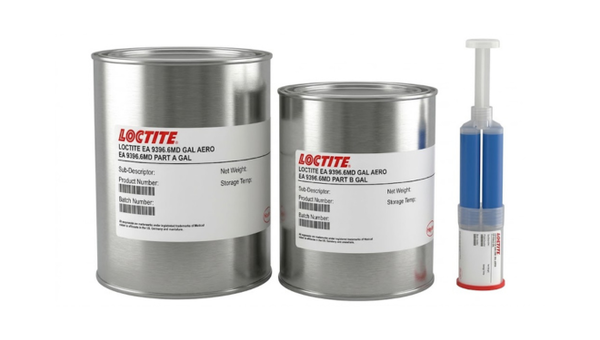
 LOCTITE EA 9396.6MD two-part syntactic epoxy adhesive system.
As-supplied properties
Values are source-reported and typical where indicated. Preserve component identity, ratio basis, mixed mass, temperature and test context during process evaluation.
| Property | Value | Unit | Method / condition |
|---|---|---|---|
| Product form | Two-part syntactic epoxy adhesive | N/A | Resin and hardener require mixing before application. |
| Part A appearance | Light blue | N/A | As-supplied resin. |
| Part B appearance | White | N/A | As-supplied hardener. |
| Mixed appearance | Light blue | N/A | After complete mixing. |
| Mix ratio | 100:31 | By weight | Resin to hardener. |
| Part A density | 0.72 | Unit not stated | The TDS reports the numerical density without an explicit unit. |
| Part B density | 0.5 | g/mL | As-supplied hardener. |
| Mixed density | 0.63 | g/mL | Mixed adhesive. |
| Pot life | 120 | Minutes | 100 g mixed mass at 25 degrees C in a water bath; ASTM D2471. |
Mixing, application, and cure
Control component temperature, the weight ratio, mixed mass, surface preparation, assembly support and cure schedule. Pot life is reported for a 100 g mass, while the supplier separately limits batch size to 450 g because larger masses can generate hazardous exotherm.
Store in unopened containers in a dry location and do not return dispensed material to the original container. The TDS states a 12-month shelf life at or below -18 degrees C in original unopened containers; component data also list Part A at 365 days at 4 degrees C or -18 degrees C, and Part B at 365 days at 4 degrees C or 180 days at or below 28 degrees C. Review the current container label and SDS before handling. Part A is classified for skin and eye irritation and skin sensitization; Part B is classified for severe skin burns and eye damage and skin sensitization. Use adequate ventilation and the protective equipment required for the task.
Cured material properties
These are typical cured-material results under the stated cure, specimen and test conditions. They are not guaranteed design allowables.
| Property | Value | Unit | Method / condition |
|---|---|---|---|
| Shore hardness | 70 | Durometer D | Cured 5 days at 25 degrees C; approximately 6.35 mm thick specimen. |
| Glass transition temperature, dry Tg by E prime | 64 | degrees C | Cured 5 days at 25 degrees C; DMA conditions reported in the TDS footnote. |
| Glass transition temperature, dry Tg by E prime | 112 | degrees C | Cured 1 hour at 82 degrees C; DMA conditions reported in the TDS footnote. |
| Coefficient of thermal expansion above Tg | 40 | ppm | ASTM E831-05; cured 5 days at 25 degrees C. |
| Coefficient of thermal expansion below Tg | 78 | ppm | ASTM E831-05; cured 5 days at 25 degrees C. |
| Thermal diffusivity | 0.0015 | cm2/s | ASTM E1461; cured 5 days at 25 degrees C. |
| Specific heat | 0.99 | J/g | ASTM E1461; cured 5 days at 25 degrees C. |
| Thermal conductivity | 0.147 | W/mK | ASTM E1461; cured 5 days at 25 degrees C. |
| Tensile strength at 25 degrees C | 20.7 | MPa | ASTM D638; 3.18 mm castings; cured 90 minutes at 82 degrees C. |
| Tensile modulus at 25 degrees C | 2,000 | MPa | ASTM D638; 3.18 mm castings; cured 90 minutes at 82 degrees C. |
| Elongation at break | 2 to 3 | % | ASTM D638; 3.18 mm castings; cured 90 minutes at 82 degrees C. |
Mechanical and dielectric performance
The supplier reports temperature-dependent compression and lap-shear results plus X-band dielectric data. Each result applies to the documented specimen, cure, substrate and test configuration and should be validated in the intended assembly.
Evaluate LOCTITE EA 9396.6MD with Krayden
Krayden can help review potting or edge-fill geometry, component and surface preparation, mix and dispense controls, batch size, cure selection, thermal and dielectric requirements, and the relevance of the published mechanical data to your assembly. Contact the team to discuss product selection, samples or a technical evaluation plan.