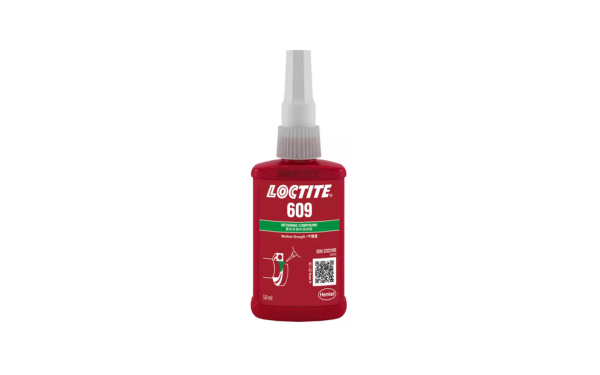
LOCTITE 609
Harmonization Code : 3403.19 | Lubricating Preparations (With 70% or More Petroleum Oils) For Automotive and Other Uses
Main features
- High-Strength Cylindrical Retention
- Low-Viscosity Retention Application
- Vibration and Fluid Resistance
Product Description
LOCTITE® 609™ is a one-component, high-strength anaerobic retaining compound designed for bonding close-fitting cylindrical metal parts. The low-viscosity green methacrylate ester liquid cures when confined between mating metal surfaces in the absence of air, helping prevent loosening and leakage caused by shock and vibration. Typical applications include securing bushings and sleeves in housings or on shafts, bonding rotor assemblies, and augmenting press, slip, and shrink fits.
Key features
- High-strength cylindrical retention: Develops compressive shear strength of at least 15.8 N/mm² on steel pins and collars after 24 hours.
- Low-viscosity gap penetration: Supports close-fitting slip, press, and shrink-fit assemblies with controlled bond gaps.
- Vibration and fluid resistance: Helps prevent movement and leakage while retaining strength after exposure to oils, fuels, brake fluid, ethanol, and water/glycol.
TDS, SDS & Technical Documents
Technical Specifications
General Properties
Physical Properties
Additional Information
As-supplied / before-processing properties
Typical properties of the uncured material; values are reference data rather than guaranteed product specifications.
| Property | Value | Unit | Method / condition |
|---|---|---|---|
| Technology | Acrylic | — | Uncured material |
| Chemical type | Methacrylate ester | — | Uncured material |
| Appearance | Green liquid | — | Uncured material |
| Fluorescence | Positive under UV light | — | Inspection aid |
| Components | One component | — | No mixing required |
| Viscosity classification | Low | — | Retaining application |
| Cure mechanism | Anaerobic | — | Cures when confined between close-fitting metal surfaces without air |
| Secondary cure | Activator | — | May improve cure speed on inactive surfaces or larger gaps |
| Strength classification | High | — | Cylindrical retaining application |
| Specific gravity | 1.1 | — | At 25°C; TDS value |
| Viscosity | 110–140 | mPa·s | Cannon-Fenske, ISO 3104 |
| Density | 1.1 | g/cm³ | At 20°C; SDS value |
| Flash point | >100 | °C | Tagliabue closed cup; SDS value |
After-processing / final-state properties
Typical cured-material properties depend on substrate, bond gap, temperature, activator use, cure time, surface condition, and test method.
| Property | Value | Unit | Method / condition |
|---|---|---|---|
| Coefficient of thermal expansion | 80 × 10−6 | K−1 | ISO 11359-2 |
| Thermal conductivity | 0.1 | W/(m·K) | ISO 8302 |
| Specific heat | 0.3 | kJ/(kg·K) | Typical cured-material property |
| Elongation at break | <2 | % | ISO 37 |
| Compressive shear strength | ≥10.3 | N/mm² | ISO 10123; steel pins and collars; cured 1 hour at 22°C |
| Compressive shear strength | ≥15.8 | N/mm² | ISO 10123; steel pins and collars; cured 24 hours at 22°C |
| Motor-oil resistance | 100 | % initial strength | MIL-L-46152 motor oil at 125°C; 1,000-hour exposure |
| Unleaded-gasoline resistance | 100 | % initial strength | At 22°C; 1,000-hour exposure |
| Brake-fluid resistance | 100 | % initial strength | At 22°C; 1,000-hour exposure |
| Water/glycol resistance | 80 | % initial strength | 50/50 water/glycol at 87°C; 1,000-hour exposure |
| Ethanol resistance | 100 | % initial strength | At 22°C; 1,000-hour exposure |
| Acetone resistance | 85 | % initial strength | At 22°C; 1,000-hour exposure |