Loctite STYCAST 3103
Harmonization Code : 3907.30.00.15 | Epoxide resin, halogen-free
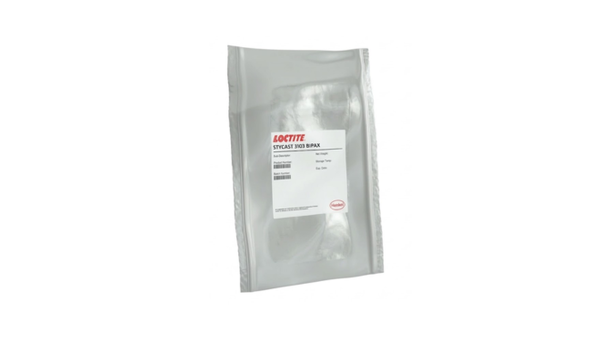
Main features
- Low-Viscosity Solvent-Free Epoxy
- Room-Temperature or Heat Cure
- Electrically Insulating Epoxy
Product Description
LOCTITE® STYCAST 3103 BIPAX is a black, two-part, solvent-free epoxy casting compound for potting and encapsulation applications requiring mechanical, thermal, and electrical insulating properties. The low-viscosity system mixes at a 100:10.5 resin-to-hardener ratio by weight and can be cured at room temperature or with heat. Once cured, it provides resistance to thermal shock, impact, chemicals, and environmental exposure across an operating temperature range of -60 to 145°C.
Key features
- Electrical insulation: Formulated for applications requiring electrically insulating encapsulation.
- Low-viscosity processing: Provides a mixed viscosity of 4,000 mPa·s (cP) at 25°C for casting and potting.
- Flexible cure options: Cures in 24 hours at 25°C or 4 hours at 65°C.
- Durable cured performance: Resists thermal shock, impact, chemicals, and environmental exposure.
- Low-outgassing and cytotoxicity testing: Passes NASA outgassing standards and ISO 10993-5 elution cytotoxicity testing.
Applications / Suitable for
- Potting and encapsulation
- Applications requiring mechanical, thermal, and electrical insulating properties
- Use with glass, ceramic, most metals, potting shells, and other plastics
TDS, SDS & Technical Documents
Technical Specifications
General Properties
ColorColor
blackComponent SystemComponent System
two partMix RatioMix Ratio
100 : 10.5Thermal Properties
Glass Transition Temperature (Tg)Glass Transition Temperature (Tg)
80 °COperating TemperatureOperating Temperature
-60 to 145 °CThermal ConductivityThermal Conductivity
5×10^-1 W/m.KElectrical Properties
Volume ResistivityVolume Resistivity
4×10^16 Ohms⋅cmAdditional Information
Technical properties
After-processing / final-state properties
Typical cured properties. Values are not intended for use as specifications.
| Property | Value | Unit | Method / condition |
|---|---|---|---|
| Operating temperature | -60 to 145 | °C | Cured material |
| Coefficient of thermal expansion | 3.5 × 10⁻⁵ | cm/cm/°C | Typical cured property |
| Glass transition temperature (Tg) | 80 | °C | Ultimate |
| Hardness | 85 | Shore D | Typical cured property |
| Reactive solids content | 100 | % | Typical cured property |
| Thermal conductivity | 5 × 10⁻¹ | W/(m·K) | Typical cured property |
| Heat distortion temperature | 102 | °C | Typical cured property |
| Volume resistivity | 4 × 10¹⁶ | ohm·cm | At 25°C |
| Volume resistivity | 4 × 10¹⁴ | ohm·cm | At 100°C |
| Dielectric strength | 510 | volts/mil | Typical cured property |
| Dielectric constant / dissipation factor | 4.1 / 0.01 | — | At 25°C and 1 kHz |
| Dielectric constant / dissipation factor | 3.8 / 0.01 | — | At 25°C and 100 kHz |
| Lap shear strength, aluminum to aluminum | 18 (2,600) | N/mm² (psi) | Typical cured performance |