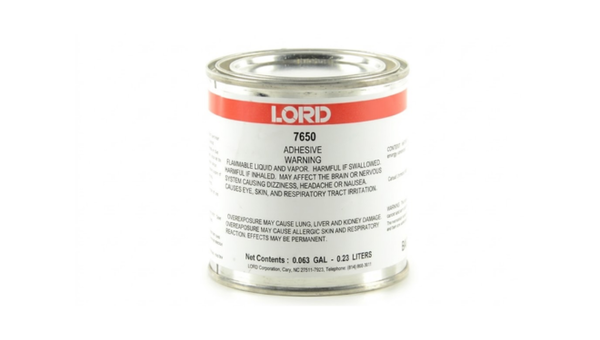
LORD 7650
Harmonization Code : 3919.10.80 | Other self-adhesive plastic rolls not exceeding 20 cm wide.
Main features
- One-Part Moisture-Cure Urethane
- 15 to 30-Minute Solvent Flash
- Multi-Material Foam/Fabric/Rubber/Plastic/Metal Bonding
Product Description
LORD® 7650 Urethane Adhesive is a single-component, solvent-borne, moisture-cure urethane adhesive that initially behaves like a contact adhesive and then permanently cross-links as cure develops. It bonds open-cell polyethylene foam, Styrofoam, urethane foam, plastic, fabric, rubber, and prepared metal. The honey-coloured liquid requires no mixing and can be applied by roll coat, spray, brush, or flow coat to one substrate surface. Typical published properties include 400–2,000 cP viscosity, 61–66% solids by weight, a 15–30 minute solvent-flash handling window, and complete cure in approximately 1–5 days, depending on the substrates and relative humidity.
Key features
- Single-component moisture-cure urethane adhesive requiring no mixing
- High initial tack and green strength after solvent flash
- One-sided application unlike conventional two-sided contact adhesive
- 400–2,000 cP viscosity for roll, spray, brush, or flow coating
- Bonds foam, fabric, rubber, plastics, Styrofoam, and prepared metals
- Good impact resistance and resistance to water and chemicals
- Room-temperature cure without an oven or external heat source
Applications
- Gaskets and foam laminations
- Tank linings and rubber-to-substrate bonding
- Automotive interiors and carpeting
- Construction panels and flooring
TDS, SDS & Technical Documents
Technical Specifications
General Properties
Physical Properties
Thermal Properties
Additional Information
LORD® 7650 Urethane Adhesive
A honey-coloured liquid adhesive that develops initial contact-like tack and then permanently cross-links through atmospheric moisture. It supports one-sided application and room-temperature processing for foam, fabric, rubber, plastics, Styrofoam, and prepared-metal assemblies.
.png)
Low-viscosity honey-coloured liquid containing MEK and toluene
| Property | Typical value | Test or claim context |
|---|---|---|
| Appearance | Honey liquid | Visual description in DS3459. |
| Viscosity | 400–2,000 cP | Brookfield LVT, spindle 2, 12 rpm. |
| Density | 935–1,007 kg/m³ | Equivalent to 7.8–8.4 lb/gal. |
| Solids content | 61–66% by weight | The balance includes volatile solvent. |
| Flash point | 3°C | Seta flash-point method; highly flammable processing implications. |
| Published solvents | Methyl ethyl ketone and toluene | Current SDS and local controls govern exposure and handling. |
Clean the substrate and apply to one bonding surface
- Remove grease, dirt, dust, moisture, release agents, rust, and other contaminants.
- For plastics, use a dry-rag wipe or a validated solvent-dampened rag.
- For metals, prime or grit blast and then solvent wash for optimum performance.
- For cured rubber, apply LORD 7701 and allow it to flash off before LORD 7650 application.
- Apply by roll coat, spray, brush, or flow coat.
- Apply to one substrate side only; a conventional two-sided contact-adhesive process is not required.
- Control wet-film coverage, overspray, edge migration, and solvent ventilation.
- Mate parts only after the required flash condition is achieved and the application remains within the validated assembly window.
.png)
Separate the handling-strength flash stage from final cross-linking
Handling strength is achieved after approximately 15–30 minutes of solvent flash.
Complete moisture cure takes approximately 1–5 days, depending on the substrates and relative humidity.
Low moisture availability, impermeable substrates, thick films, or sealed joints can slow cure development.
The system cures without an oven or external heat source, but the actual environment must still be qualified.
Storage and industrial safety
Shelf life is six months from date of shipment when stored at 21–27°C in the original unopened container. After opening, protect the adhesive from moisture with approved desiccant cartridges or dry nitrogen. LORD 7650 has a published 3°C flash point and contains MEK and toluene. Use only with trained personnel, explosion-appropriate process controls, effective ventilation, ignition-source control, suitable personal protection, and the current regional SDS and package label. The supplied file identified only as “rehsfil0” could not be verified as a readable product-specific safety document.
Substrate-specific peel results after 48 hours at 50% relative humidity
The TDS reports bond strength in pounds per linear inch after a 48-hour cure at 50% RH. Failure modes are important: foam tear, thin-rubber tear, or rubber tear indicate substrate failure under the stated test rather than a universal adhesive-strength limit.
| Substrate combination | Typical bond strength | Reported failure mode |
|---|---|---|
| Polyethylene foam to aluminium or steel | 15–18 pli | Foam tear |
| Vinyl to foam | 5–8 pli | Foam tear |
| Vinyl to aluminium | 30–35 pli | Not stated in the table |
| Rubber to metal | 15–20 pli | Thin rubber tear |
| Styrofoam to epoxy-primed galvanised steel | 15–20 pli | Foam tear |
| Rubber to concrete | 14–17 pli | Rubber tear |
Use initial tack for assembly while allowing moisture access for final cure
Published applications include gaskets, tank linings, automotive interiors, carpeting, construction panels, and flooring. Final qualification should address substrate porosity, solvent sensitivity, foam attack, wet-film coverage, flash time, open time, humidity access, cure depth, trapped solvent, odour, emissions, vertical flow, press or fixture requirements, cleaning, water and chemical exposure, and long-term environmental durability.
Open-cell polyethylene foam, urethane foam, Styrofoam, fabric, vinyl, and carpet constructions after compatibility testing.
Gaskets, linings, and rubber-to-metal or rubber-to-concrete joints using the specified surface treatment where required.
Automotive interiors, construction panels, and flooring where solvent flash and cure ventilation can be controlled.
LORD 7650 technical and bonding guidance
Product-specific technical data for substrates, preparation, application, solvent flash, moisture cure, storage, as-supplied properties, and bond results.
Open resourceGeneral joint-design, surface-preparation, application, fixturing, failure-mode, cleanup, and qualification guidance.
Open resourceGeneral LORD adhesive selection context. Product-specific values remain governed by DS3459.
Open resourceValidate LORD® 7650 for your foam, rubber, fabric, or panel assembly
Krayden can help review substrate preparation, coating method, wet-film coverage, one-sided application, solvent flash, ventilation, humidity access, cure time, foam compatibility, bond testing, and production safety controls.