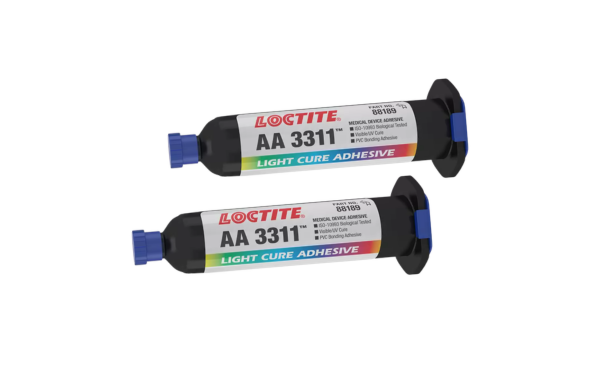
LOCTITE AA 3311
Harmonization Code : 3919.10.80 | Other self-adhesive plastic rolls not exceeding 20 cm wide.
Main features
- High Speed Light Cure
- Multi-Substrate Urethane Bonding
- Medical Devices Urethane Bonding
Product Description
LOCTITE® AA 3311™ is a one-component, low-viscosity, UV- and visible-light-curing acrylic adhesive designed for high-speed bonding of rigid or flexible PVC to polycarbonate and for joining glass, many plastics, and most metals. Its flexible cured structure helps absorb shock and distribute load across the bond area, while its low viscosity supports close-fitting assemblies and small bond gaps. The product is intended for production applications, including disposable medical-device assembly, and has been evaluated using Henkel test protocols based on ISO 10993 biocompatibility standards.
Key features
- High-speed light cure: Fixtures in as little as five seconds under specified UV or LED exposure conditions.
- Flexible multi-substrate bonding: Bonds polycarbonate, PVC, glass, many plastics, and most metals while supporting shock absorption and load distribution.
- Medical-device assembly suitability: Designed for disposable medical-device applications and tested to Henkel protocols based on ISO 10993 standards.
TDS, SDS & Technical Documents
Technical Specifications
General Properties
Physical Properties
Additional Information
As-supplied / before-processing properties
Typical uncured and processing properties; cure response depends on light source, irradiance, wavelength, exposure time, bond gap, and substrate transmission.
| Property | Value | Unit | Method / condition |
|---|---|---|---|
| Technology | Acrylic | — | Light-curing adhesive technology |
| Chemical type | Acrylated urethane | — | Uncured material |
| Appearance | Transparent to light-yellow liquid | — | TDS lists transparent liquid; SDS lists light yellow |
| Components | One component | — | Requires no mixing |
| Viscosity classification | Low | — | TDS classification |
| Cure mechanism | Ultraviolet / visible light | — | Radiation cure at approximately 220–260 nm and suitable UV/visible wavelengths |
| Specific gravity | 1.1 | — | At 25°C; TDS |
| Dynamic viscosity | 300 | mPa·s | Brookfield RVT, 25°C, spindle 1, 20 rpm |
| Density | 1.1013 | g/cm³ | At 20°C; SDS |
| Flash point | 77.2 | °C | Pensky-Martens closed cup; SDS |
| Auto-ignition temperature | 485 | °C | SDS |
| Kinematic viscosity | >20.5 | mm²/s | At 40°C; SDS |
| Maximum recommended bond gap | 0.25 | mm | Typical application guidance |
| Stress-cracking time | 15 | min | ASTM D3929; medical-grade polycarbonate bar under 7 N/mm² stress |
| Stress-cracking time | 4 | min | ASTM D3929; medical-grade polycarbonate bar under 12 N/mm² stress |
| LED fixture time | 5 | s | Glass slides; 514 mW/cm² at 405 nm |
| LED fixture time | 5 | s | Glass slides; 100 mW/cm² at 365 nm |
| Black-light fixture time | 15 | s | Glass slides; 6 mW/cm² at 365 nm |
| Polycarbonate fixture time | 5 | s | Metal-halide source, 30 mW/cm² at 365 nm |
After-processing / final-state properties
Typical cured properties shown for material cured with a metal-halide source at 30 mW/cm², measured at 365 nm, for 80 seconds unless otherwise stated.
| Property | Value | Unit | Method / condition |
|---|---|---|---|
| Shore hardness | 64 | Shore D | ISO 868 |
| Refractive index | 1.5 | — | Typical cured material |
| Water absorption | 5.36 | % | ISO 62; two hours in boiling water |
| Elongation at break | 265 | % | ISO 527-3 |
| Tensile strength at break | 23 | N/mm² | ISO 527-3 |
| Tensile modulus | 669 | N/mm² | ISO 527-3 |
| Dielectric constant / dissipation factor | 4.56 / 0.05 | — | IEC 60250; 100 Hz |
| Dielectric constant / dissipation factor | 4.41 / 0.02 | — | IEC 60250; 1 kHz |
| Dielectric constant / dissipation factor | 4.02 / 0.03 | — | IEC 60250; 1 MHz |
| Dielectric breakdown strength | 31 | kV/mm | Typical cured material |
| Surface resistivity | 1.0 × 10¹⁵ | Ω | IEC 60093 |
| Volume resistivity | 8.4 × 10¹⁴ | Ω·cm | IEC 60093 |
| Lap-shear strength | 5.2 | N/mm² | Polycarbonate, 0.5 mm gap; substrate failure reported |
| Boiling-water resistance | 100 | % initial strength | 100°C; two-hour exposure; polycarbonate; substrate failure |
| Water-immersion resistance | 100 | % initial strength | 49°C; 170-hour exposure; polycarbonate; substrate failure |
| Isopropanol resistance | 100 | % initial strength | 21°C; 24-hour exposure; polycarbonate; substrate failure |
| Heat/humidity resistance | 100 | % initial strength | 38°C; 170-hour exposure; polycarbonate; substrate failure |
| Heat-aging strength retention | 100 | % initial strength | Polycarbonate; 71°C or 93°C for 170 or 340 hours; substrate failure |