LOCTITE AA 330
Harmonization Code : 3506.91.90.99 | Prepared glues and other prepared adhesives, not elsewhere specified or included; products suitable for use as glues or adhesives, put up for retail sale as glues or adhesives, not exceeding a net weight of 1 kg ; Adhesives based on polymers of headings 3901 to 3913 or on rubber; Other ; Other
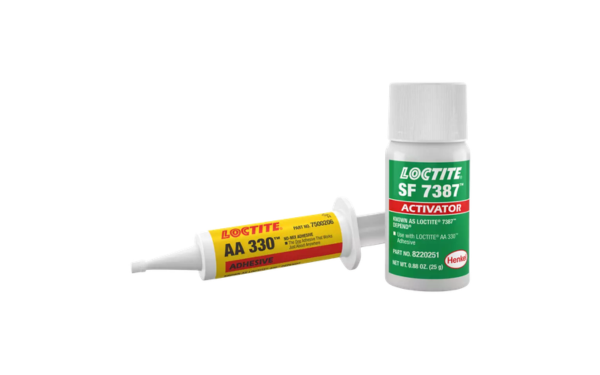
Main features
- Multi-Material Urethane Bonding
- One-Component Application Urethane Bonding
- High-Strength Structural Bonding
Product Description
LOCTITE® AA 330 is a one-component, high-viscosity, activator-cured acrylic adhesive for general-purpose bonding of metal, wood, ferrite, ceramic, and plastic materials. The slightly cloudy, colorless-to-pale-yellow liquid requires no mixing and is commonly used for tool handles, appliances, sporting goods, and decorative trim. Under specified test conditions, it develops high lap-shear and tensile strength on grit-blasted mild steel and supports bond gaps up to 0.5 mm when used with LOCTITE Activator 7387 or 7386.
Key features
- Multi-material bonding: Suitable for bonding metals, wood, ferrite, ceramics, and compatible plastics.
- One-component application: Requires no adhesive mixing and cures rapidly when paired with the specified activator.
- High-strength, gap-tolerant performance: Provides 15–30 N/mm² lap-shear strength on grit-blasted mild steel and supports gaps up to 0.5 mm under specified application conditions.
TDS, SDS & Technical Documents
Technical Specifications
General Properties
Physical Properties
Additional Information
As-supplied / before-processing properties
Typical properties of the uncured material; values are reference data and may vary by test method and production batch.
| Property | Value | Unit | Method / condition |
|---|---|---|---|
| Technology | Acrylic | — | TDS product classification |
| Chemical type | Urethane methacrylate ester | — | Uncured material |
| Appearance | Slightly cloudy, colorless to pale-yellow liquid | — | TDS description; current SDS lists amber liquid |
| Components | One component | — | Requires no mixing |
| Viscosity classification | High | — | TDS classification |
| Cure system | With activator | — | LOCTITE Activator 7387 or 7386 |
| Specific gravity | 1.05 | — | At 25°C |
| Brookfield viscosity | 45,000–90,000 | mPa·s | Brookfield RVT, 25°C, spindle 7, 20 rpm; TDS |
| Cone-and-plate viscosity | 30,000–70,000 | mPa·s | EN 12092-SV, 25°C, after 180 s, shear rate 20 s⁻¹ |
| Dynamic viscosity | 50,000–80,000 | mPa·s | Brookfield RVT, 25°C, spindle 7, 20 rpm; current SDS |
| Kinematic viscosity | 47,600–76,100 | mm²/s | At 25°C; current SDS |
| Density | 1.05 | g/cm³ | At 20°C; current SDS |
| pH | 10 | — | 20°C, 100% product; current SDS |
| Flash point | 83 | °C | Tagliabue closed cup; current SDS |
| Recommended bondline gap | 0.1 | mm | TDS application guidance |
| Maximum stated bond gap | 0.5 | mm | Activator required on both surfaces; immediate assembly |
After-processing / final-state properties
Typical cured properties depend on substrate, activator, bond gap, cure time, temperature, and test method.
| Property | Value | Unit | Method / condition |
|---|---|---|---|
| Coefficient of thermal expansion | 151 × 10−6 | K−1 | ISO 11359-2; −25°C to 100°C |
| Thermal conductivity | 0.1 | W/(m·K) | ISO 8302 |
| Specific heat | 0.3 | kJ/(kg·K) | Typical cured material |
| Lap-shear strength | 15–30 | N/mm² | ISO 4587, grit-blasted mild steel, 24 h at 22°C, Activator 7387 on one side |
| Tensile strength | 12–22 | N/mm² | ISO 6922, grit-blasted mild steel |
| Lap-shear strength, two-sided activator | ≥16.5 | N/mm² | ISO 4587, grit-blasted mild steel, 24 h at 22°C, Activator 7387 or 7386 on both sides |
| Acetone resistance | 10 | % initial strength | 22°C exposure; 350 h and 720 h |
| Motor-oil resistance | 90 / 66 | % initial strength | MIL-L-46152 motor oil at 87°C; 350 h / 720 h |
| Unleaded-gasoline resistance | 20 | % initial strength | 22°C exposure; 350 h and 720 h |
| Phosphate-ester resistance | 93 / 75 | % initial strength | 87°C exposure; 350 h / 720 h |
| Water/glycol resistance | 60 | % initial strength | 50/50 water/glycol at 87°C; 350 h and 720 h |
| Heat-aging strength retention | Approx. 100 | % initial strength | 5,000 h at 100°C; tested at 23°C; chart-derived |
| Heat-aging strength retention | Approx. 62 | % initial strength | 5,000 h at 120°C; tested at 23°C; chart-derived |