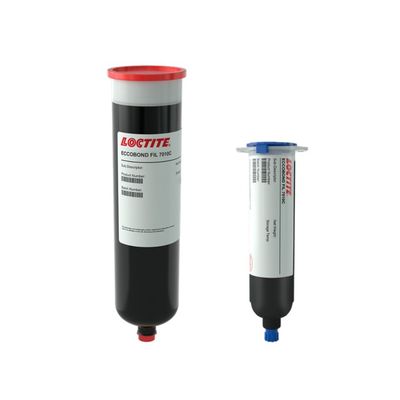
LOCTITE ECCOBOND 7010C FIL
Harmonization Code : 3907.30.00.85 | Polyacetals, other polyethers and epoxide resins, in primary forms; polycarbonates, alkyd resins, polyallyl esters and other polyesters, in primary forms : Epoxide resins : Other
Main features
- Fill Encapsulant
- Low CTE
- High purity
Product Description
LOCTITE ECCOBOND FIL 7010C is a low viscosity, one component, SVHC free, epoxy product designed for use as a potting or encapsulation resin protection for stress sensitive electronic components. It is specially formulated with a low thermal expansion and high Tg, along with a toughened polymer backbone making it ideally suited to survive severe thermal shock conditions with a high resistance to micro cracking.
LOCTITE ECCOBOND FIL 7010C is a REACH compliant product, designed to survive constant service temperatures of 150°C, with peak temperatures of up to 180°C for chip on board encapsulation.
Cure Schedule
- 2 hours @ 140°C
- 1 hour @ 100°C plus 1 hour @ 150°C (Low Stress)
ECCOBOND FIL 7010C
Unlike other products we offer, the products listed on this page cannot currently be ordered directly from the website.
 Shipping in 35 days
 Shipping in 12 weeks
 Shipping in 20 days
Technical Specifications
Electrical Properties
Physical Properties
Thermal Properties
Additional Information

Why is FIL7010C considered a "Green" product compared to FP4470?
As you can imagine, the formulations of FP4470 and FIL7010C are different.
FP4470 contains a substance of very high concern "Hexahydromethylphthalic anhydride" (CAS no. 25550-51-0) which is used as an epoxy hardener.
The SVHC list is determined based on the dangers and concerns on an individual substance/molecule basis.

Hexahydromethylphthalic anhydride (CAS no. 25550-51-0)
The FIL7010C formulation does NOT currently contain any substances on the SVHC list and that is why it is considered a less harmful formulation.
For the Chemistry enthusiasts, the epoxy hardener part in the FIL7010C formulation is similar, but still completely different.

Methyltetrahydrophthalic anhydride (CAS No. 11070-44-3).
Directions for use
- Cure the product per the cure schedule mentioned in the Typical Cure Schedule section of the document.
- The surfaces on which the adhesive has to be applied should be clean, dry and free from all dust.
- Initially dispense LOCTITE ECCOBOND FIL 7010C on the outline of the glob referred to as the "dam".
- The dam is then filled in with LOCTITE ECCOBOND FIL 7010C material.
- Both materials can be co-cured after dispense.
For the low stress schedule we need to point out that according to the DSC curve the cure reaction barely starts at 100-125C. Yes, it happens and yes it is a low stress alternative but given the oven temperature tolerances, batch to batch variations etc we always run the risk of inconsistent results. You should always develop a process that works for your application but for repeatable and predictable results we recommend curing at least at 140°C.
Alternative schedules that could reduce warpage are:
- Gelling temp to 150C and run basically straight 2 hours 150C, and or
- Gelling temp to 150C for 30min followed by 1.5 hours at 160C, and or
- Simply run a straight 2 hours 160C