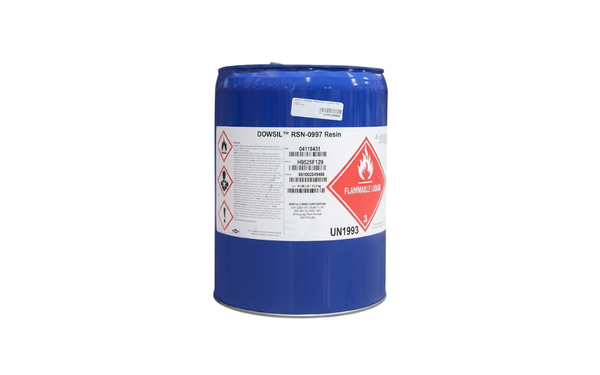
DOWSIL RSN-0997
Harmonization Code : 3910.00.00.90 | Silicones in Primary Forms; Others
Main features
- Silicone Impregnating Resin for Windings
- 90 to 120 cP Viscosity Range
- 2,000 V/mil Dry Dielectric Strength
Product Description
DOWSIL RSN-0997 Resin is a dark-brown, solvent-based silicone impregnating resin used to electrically insulate motor, generator, solenoid, and transformer windings. The resin is formulated for dip impregnation with controlled viscosity, staged drying, and thermal cure. Its cured electrical properties are documented both before and after distilled-water immersion conditioning. Documented applications include motor stator coils, generator coils and solenoids, and transformer windings. RSN-0997 is used as an impregnation resin rather than a bulk potting material.
Key features
- Flow and dispensing: Dark-brown silicone impregnating resin with typical 90-120 cP viscosity at 25 deg C and 50% nonvolatile content.
- Key characteristic: Documented winding process uses 150-200 deg C pre-bake, cooling to about 80 deg C, and 3-5 minute dip impregnation.
- Electrical performance: After 6 h at 200 deg C, dielectric strength is 2000 V/mil under Condition A and 1500 V/mil after 24 h distilled-water immersion.
Applications
- Motor stator coils
- Generator coils and solenoids
- Transformer windings
TDS, SDS & Technical Documents
Technical Specifications
General Properties
Physical Properties
Electrical Properties
Additional Information
Electrical Insulating Resins
Silicone impregnation resin for coils and windings
DOWSIL RSN-0997 Resin is a dark-brown, solvent-based silicone impregnating resin used to electrically insulate motor, generator, solenoid, and transformer windings. The resin is formulated for dip impregnation with controlled viscosity, staged drying, and thermal cure. Its cured electrical properties are documented both before and after distilled-water immersion conditioning.
As-Supplied Properties
Liquid resin properties before impregnation
As-supplied viscosity and solids content are important to penetration of windings and control of the dip process.
| Property | Typical Value | Unit / Condition | State |
|---|---|---|---|
| Color | Dark brown | - | As supplied |
| Nonvolatile content | 50 | % after 3 h at 135 deg C | As supplied |
| Specific gravity | 1.00 | at 25 deg C | As supplied |
| Viscosity | 90-120 | cP at 25 deg C | As supplied |
| Drying time | 3 | h at 200 deg C | Applied resin |
| Solvent | Xylene | - | As supplied |
Processing
Prepare the equipment, impregnate, dry, and thermally cure
RSN-0997 is used as an impregnation resin rather than a bulk potting material. The documented process emphasizes moisture removal, controlled immersion time, staged drying, and cure temperature appropriate to the equipment.
- Pre-bake:Thoroughly clean the equipment and pre-bake at 150-200 deg C to drive out moisture and cure new insulating components.
- Cool before dipping:Allow the equipment to cool to about 80 deg C before immersion.
- Impregnate:Dip in RSN-0997 for 3-5 minutes, or until most bubbling stops. Do not exceed 10 minutes of immersion.
- Build the coating:Air dry and partially cure the first coat, then cool to about 80 deg C before a further impregnation. Two dips will usually provide sufficient resin build-up.
- Cure:Select the cure according to equipment size, desired film properties, and oven behavior. For maximum bond strength, use a final cure at 250 deg C for at least 6 h.
Storage & Handling
Long unopened-container usable life at 25 deg C
When stored at or below 25 deg C in the original unopened container, the product has a documented usable life of 36 months from the date of production.
Technical Guidance
Maintain penetration and control resin build-up
Dip-tank viscosity, film build, and cure temperature are key process controls for impregnation performance.
Maintain dip-tank viscosity
If resin viscosity rises above 200 centistokes, penetration into windings may be reduced and air spaces can remain. Check viscosity and add suitable thinner only when needed.
Avoid excessive build
Excessive resin build-up may lead to crazing. If dip-tank resin becomes too thick or deteriorates, it should be removed from service rather than forced through the process.
Set cure relative to service
Set the final cure temperature at least 20 deg C above the maximum operating temperature of the impregnated equipment.
Final-State Properties
Electrical properties after a 6 h cure at 200 deg C
Condition D represents specimens after 24 h immersion in distilled water. The comparison preserves the conditioning basis reported in the product data.
| Property | Condition A | Condition D | Unit / Test Condition |
|---|---|---|---|
| Dielectric strength | 2000 | 1500 | V/mil; 2 in electrodes |
| Dissipation factor | 0.010 | 0.020 | at 25 deg C, 100 Hz |
| Dissipation factor | 0.007 | 0.010 | at 25 deg C, 100 kHz |
| Dielectric constant | 3.10 | 3.20 | at 25 deg C, 100 Hz |
| Dielectric constant | 2.98 | 3.10 | at 25 deg C, 100 kHz |
| Surface resistivity | 1 x 10^14 | 1 x 10^13 | ohm |
| Volume resistivity | 2 x 10^14 | 1 x 10^14 | ohm-cm |
Performance Evidence
Thermal-life data from the curved-electrodes method
Thermal-life testing reports time-to-endpoint values at three elevated temperatures for glass cloth impregnated with RSN-0997 Resin.
250 deg C
4000 h
Reported aging time to the defined dielectric-strength endpoint.
275 deg C
1500 h
Reported aging time to the defined dielectric-strength endpoint.
300 deg C
350 h
Reported aging time to the defined dielectric-strength endpoint.
Test endpoint: hours of aging required to reduce dielectric strength of glass cloth impregnated with RSN-0997 Resin to 300 V/mil when the resin film is elongated 2%.
Applications
Electrical winding impregnation
The product is documented as an electrical insulating impregnant for several coil and winding types.
Motor stator coils
Impregnation of motor stator coils to form an electrically insulating cured resin film around the winding system.
Generator coils and solenoids
Electrical insulation of generator coil and solenoid winding assemblies using the documented dip-and-cure process.
Transformer windings
Dip impregnation and thermal cure of transformer windings where a silicone insulating resin is required.
Technical support for DOWSIL RSN-0997 Resin
Need help translating the RSN-0997 dip process into a winding-impregnation trial? Krayden can help review pre-bake temperature, cooling before immersion, dip time, resin-viscosity control, film build, drying sequence, and final cure conditions for the specific motor, generator, solenoid, or transformer assembly.