DOWSIL 93-500

Harmonization Code : 3910.00.00.90 | Silicones in Primary Forms; Others
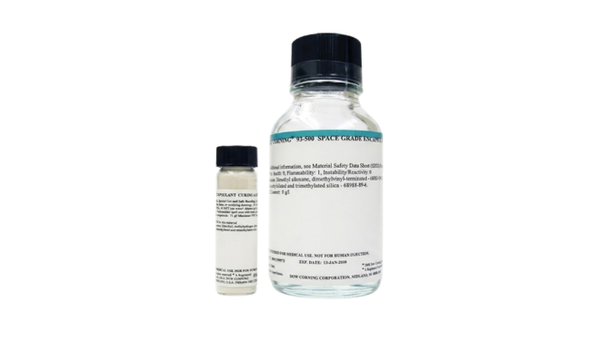
DOWSIL 93-500

Main features

  • Low-Outgassing Vacuum Bonding
  • 2.5-Hour Working Window
  • Flexible Cured Adhesive

Product Description

DOWSIL™ 93-500 Space Grade Encapsulant is a transparent, flowable, two-part addition-cure silicone elastomer for encapsulating, potting, bonding, sealing, and coating electronic and optical assemblies used in terrestrial and space systems. The base and curing agent are mixed 10:1 by weight, providing a typical 2.5-hour pot life and room-temperature or heat-accelerated cure options. After cure, the material forms a flexible rubber with a documented -115 to 200°C operating range, low thermal-vacuum outgassing, and stable mechanical and electrical properties. It is documented for PCB components and assemblies, modules, relays, connectors, solar-cell and optical assemblies, sensors, seals, and selected thermal-control coating uses.

Key features

  • Low thermal-vacuum outgassing: Typical thermal vacuum weight loss is 0.20%, with 0.01% volatile condensable material under the stated vacuum test conditions.
  • Wide operating temperature range: The cured material has a documented operating range from -115 to 200°C (-149 to 392°F).
  • Electrical insulation after cure: Typical cured values include 480 V/mil dielectric strength and 1.0 × 10¹⁵ ohm-cm volume resistivity.

Applications / Suitable for

  • Encapsulation and potting of PCB components, circuit boards, assemblies, modules, relays, and connectors
  • Bonding of solar cells, cover glasses, OSR mirrors, PCB subcomponents, optical sensors, and other sensors
  • Fay and fillet seals, formed-in-place gaskets, optical sensor seals, and selected thermal-control coating applications
Product Family

DOWSIL 93-500

Catalog Product

Unlike other products we offer, the products listed on this page cannot currently be ordered directly from the website.

TDS, SDS & Technical Documents

Technical Specifications

General Properties
ColorColor
Transparent
Specific GravitySpecific Gravity
1.03
Physical Properties
ViscosityViscosity
8,000 mPa.s
Mechanical Properties
ElongationElongation
170 %
Thermal Properties
Thermal ConductivityThermal Conductivity
0.20 W/m.K
Electrical Properties
Dielectric StrengthDielectric Strength
18 kV/mm
Volume ResistivityVolume Resistivity
1E15 Ohms⋅cm

Additional Information

POTTING, ENCAPSULANTS & UNDERFILLS

DOWSIL™ 93-500 Space Grade Encapsulant

DOWSIL™ 93-500 is a transparent, flowable, two-part silicone encapsulant developed for space-system, PCB, and optical assemblies where low thermal-vacuum outgassing is important. It cures to a flexible elastomer with a documented -115 to 200°C operating range and combines mechanical protection functions with electrical insulation properties for encapsulation, potting, bonding, sealing, and coating applications.

Two-part silicone elastomer Transparent flowable grade 10:1 mix ratio by weight 2.5-hour typical pot life Low thermal-vacuum outgassing -115 to 200°C operating range
DOWSIL 93-500 Space Grade Encapsulant two-part base and curing-agent kit

Product image: DOWSIL™ 93-500 Space Grade Encapsulant base and curing-agent kit.

MATERIAL STATE

As-supplied properties

Appearance
Transparent
Transparent as supplied for visual access in optical and electronic assembly evaluations.
Viscosity
80 Poise
Typical as-supplied viscosity for the flowable DOWSIL™ 93-500 grade.
Specific gravity
1.03 g/cm³
Typical as-supplied value for material quantity and process planning.
PROCESSING

Mixing, de-airing, and cure

Prepare the substrate, mix the two components at the specified weight ratio, remove entrapped air, and select a room-temperature or heat-accelerated cure that fits the part geometry.

Surface preparation: Thoroughly clean and degrease surfaces with a suitable oil-removing solvent. Light abrasion is recommended when practical. Acetone or IPA may be used as a final wipe but should not be relied on as the primary oil-removal step.
Primer option: A very thin coat of DOWSIL™ 1200 Prime Coat or DOWSIL™ P5200 Adhesion Promoter can provide stronger and more uniform adhesion. Under typical room conditions, allow 1 to 2 hours of air drying; low humidity may require longer.
Mix ratio: Blend 10 parts base to 1 part curing agent by weight immediately before use. Variations within 10% of the curing-agent concentration have little effect; larger deviations can change hardness, strength, brittleness, and vacuum weight loss.
Vacuum de-airing: Avoid entrapping air during mixing. De-air under vacuum in a container no more than one-third full, continuing for 3 to 5 minutes after the bubbles collapse.
Cure options: Typical tack-free time is less than 16 hours, and a 1/8-inch section has a typical full-cure time of 1 day. Full mechanical, electrical, and weight-loss properties develop after 7 days at room temperature. Suggested accelerated cycles are 2 hours at 65°C, 30 minutes at 100°C, or 10 minutes at 150°C; massive parts need additional heat-up time.
Storage and handling

Store below 32°C (90°F) with containers tightly closed. Shelf life is controlled by the “Use Before” date on the product label. Complete kits contain separate base and curing-agent containers and are available in 3.9 oz (110 g) and 1.1 lb (0.5 kg) net weights.

Compatibility and adhesion guidance

Cure inhibition
Addition-cure silicone can be inhibited by organotin and other organometallic compounds, organotin-cured silicone rubber, sulfur-containing materials, amines, urethanes, unsaturated hydrocarbon plasticizers, and some solder-flux residues. Run a small-scale compatibility test when materials are uncertain; liquid or uncured material at the interface indicates inhibition.
Substrate and adhesion evaluation
Nonreactive metals and low-energy plastics such as Teflon, polyethylene, and polypropylene may require chemical etching, plasma treatment, or another appropriate surface treatment. Highly plasticized plastics and rubbers may also show poor adhesion. Evaluate the actual substrate and preparation before production trials.
Thin-section cure control
For sections 10 mil or thinner, cover the silicone surface with polyethylene during room-temperature cure or use a heat cure to reduce potential surface tack caused by airborne contaminants.
Storage and handling

Store below 32°C (90°F) with containers tightly closed. Shelf life is controlled by the “Use Before” date on the product label. Complete kits contain separate base and curing-agent containers and are available in 3.9 oz (110 g) and 1.1 lb (0.5 kg) net weights.

Compatibility and adhesion guidance

Cure inhibition
Addition-cure silicone can be inhibited by organotin and other organometallic compounds, organotin-cured silicone rubber, sulfur-containing materials, amines, urethanes, unsaturated hydrocarbon plasticizers, and some solder-flux residues. Run a small-scale compatibility test when materials are uncertain; liquid or uncured material at the interface indicates inhibition.
Substrate and adhesion evaluation
Nonreactive metals and low-energy plastics such as Teflon, polyethylene, and polypropylene may require chemical etching, plasma treatment, or another appropriate surface treatment. Highly plasticized plastics and rubbers may also show poor adhesion. Evaluate the actual substrate and preparation before production trials.
Thin-section cure control
For sections 10 mil or thinner, cover the silicone surface with polyethylene during room-temperature cure or use a heat cure to reduce potential surface tack caused by airborne contaminants.
FINAL MATERIAL STATE

Typical cured properties

Typical values are not intended for use in preparing specifications. Unless otherwise stated, properties are reported after 7 days of cure at 25°C (77°F) and 50% relative humidity.

Property Value Unit Method / condition
Refractive index 1.41 Cured 7 days at 25°C (77°F) and 50% RH
Durometer 40 Shore A points Cured 7 days at 25°C (77°F) and 50% RH
Tensile strength 975 psi Cured 7 days at 25°C (77°F) and 50% RH
Elongation 170 % Cured 7 days at 25°C (77°F) and 50% RH
Tear strength 15 ppi Die B; cured 7 days at 25°C (77°F) and 50% RH
Lap shear 475 psi Primed aluminum; cured 7 days at 25°C (77°F) and 50% RH
Thermal vacuum weight loss 0.20 % 24 hours at 125°C (257°F) and <1 × 10⁻⁶ torr
Volatile condensable material 0.01 % Collected at 25°C (77°F) during the vacuum weight-loss test
Linear coefficient of thermal expansion 300 micron/m·°C Cured 7 days at 25°C (77°F) and 50% RH
Thermal conductivity 0.20 W/m·°C Cured 7 days at 25°C (77°F) and 50% RH
Dielectric strength 480 V/mil Cured 7 days at 25°C (77°F) and 50% RH
Volume resistivity 1.0 × 10¹⁵ ohm-cm Cured 7 days at 25°C (77°F) and 50% RH
Dielectric constant 2.6 100 Hz; cured 7 days at 25°C (77°F) and 50% RH
Dielectric constant 2.6 100 kHz; cured 7 days at 25°C (77°F) and 50% RH
Dissipation factor 0.0011 100 Hz; cured 7 days at 25°C (77°F) and 50% RH
Dissipation factor 0.0002 100 kHz; cured 7 days at 25°C (77°F) and 50% RH
USE CONTEXTS

Applications

DOWSIL™ 93-500 is documented for encapsulation, bonding, sealing, and coating tasks in terrestrial and space-system electronics and optical assemblies.

Illustration of PCB components and modules being encapsulated with DOWSIL 93-500
Space and PCB encapsulation
Used to encapsulate or pot PCB components, circuit boards and assemblies, modules, relays, and connectors in terrestrial and space systems where low outgassing and flexible cured properties are important evaluation factors.
Illustration of solar-cell cover glass and optical sensor bonding with DOWSIL 93-500
Solar-cell and optical assembly bonding
Documented for bonding solar cells to substrates, cover glasses to solar cells, OSR mirrors to substrates, PCB subcomponents and subassemblies, optical sensors, and other sensors.
Illustration of fay seals, fillet seals, formed-in-place gaskets, and thermal-control coating applications
Sealing and protective coating uses
Documented for fay and fillet seals, formed-in-place gaskets and seals, optical sensor seals, binders for thermal-control paints, and coating applications involving atomic-oxygen protection.
Next steps

Evaluate DOWSIL™ 93-500 for your application

Need help evaluating DOWSIL™ 93-500 for an aerospace, PCB, optical, or space-system assembly? Krayden can help review application geometry, substrate preparation, cure compatibility, processing conditions, and the relevant thermal-vacuum, mechanical, and electrical data for your design.

Leading Brands Trust in Our Products and Services

  • Jabil
  • Linxens
  • Magna
  • Medtronic
  • NXP
  • Philips
  • Semikron
  • Teledyne
  • Thales
  • Vishay
  • ZF
  • AMS
  • Apple
  • Audi
  • Broadcom
  • Borgwarner
  • Bosch
  • Eaton
  • Henkel
  • Honeywell
  • Hysol
  • Intel
Products that Perform|Knowledge that Serves|Service that Delivers