COOLTHERM PC10882
Harmonization Code : 3910.00.00.90 | Silicones in Primary Forms; Others
Main features
- Screen-Printable Coating Application
- Thermal-Shock and Solvent-Resistant Cured Film
- Above 500 V/mil Dielectric Strength
Product Description
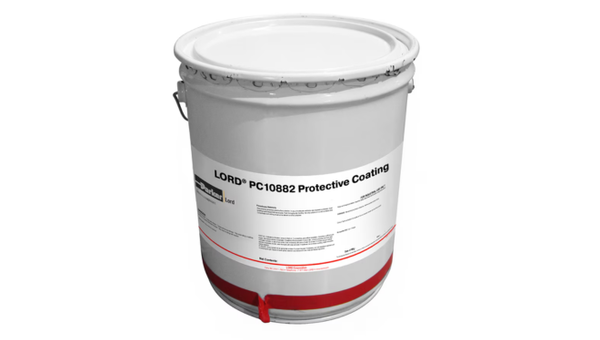
LORD® PC10882 Protective Coating is a mineral-filled epoxy dielectric paste designed for screen printing as a protective coating over trimmed resistors and for general circuit protection. The dark-blue paste has a typical 65–85 kcP viscosity at 25°C and can be applied through 100–250 mesh stainless-steel screens with organic-emulsion backing. After printing, allow the coating to level for 5–10 minutes at room temperature, oven-dry for 5–10 minutes at 150°C to remove solvent, and use 245°C for 30 minutes as the documented cure guide. The cured film provides typical insulation resistance above 1 × 10¹¹ ohm-cm at 2 mils, dielectric strength above 500 V/mil, a dielectric constant of 5–7, and dissipation factor below 1%.
Key features
- Mineral-filled epoxy dielectric coating for printed circuit protection
- Screen-printable through 100–250 mesh stainless-steel screens
- Supports squeegee velocities up to 25 cm/s with a sharp 45° squeegee
- Tough cured film positioned for thermal-shock, moisture, abrasion, oxidation, and solvent protection
- Typical dielectric strength above 500 V/mil
- LORD® 3996 thinner may be used when dilution is required
- Six-month shelf life at 25°C in the original unopened container
Applications
- Protective coating of trimmed resistors
- General circuit protection
- Screen-printed dielectric protection on validated substrates
TDS, SDS & Technical Documents
Technical Specifications
General Properties
Physical Properties
Additional Information
LORD® PC10882 Protective Coating
A mineral-filled epoxy dielectric paste designed for screen printing over trimmed resistors and for general circuit protection. The material forms a tough cured film that combines electrical insulation with documented resistance positioning against thermal shock, moisture, abrasion, oxidation, and commonly used solvents.
.png)
Printable dielectric-paste properties
PC10882 is supplied as a dark-blue paste. The technical datasheet and safety data sheet use different viscosity test descriptions, so each value remains tied to its source and method.
| Property | Typical value | Context |
|---|---|---|
| Appearance | Dark-blue paste | Mineral-filled epoxy dielectric material. |
| Viscosity at 25°C | 65–85 kcP | TDS: Brookfield RVT, spindle 6, 10 rpm. |
| SDS dynamic viscosity | ≥75,000 mPa·s at 25°C | Safety-document value; do not substitute it for the TDS processing range. |
| Density | 1.79 g/cm³ | SDS physical-property value. |
| Flash point | 73°C | Pensky-Martens closed cup; combustible-liquid handling applies. |
| VOC, calculated | 375 g/L | SDS value; regulatory interpretation is jurisdiction-dependent. |
Gently mix, screen print, level, remove solvent, and complete the high-temperature cure
Gently stir the material before use. When dilution is needed, use LORD® 3996 Thinner. Apply by screen printing through 100–250 mesh stainless-steel screens with organic-emulsion backing.
- Use a sharp squeegee with a 45° angle of attack.
- The documented maximum squeegee velocity is 25 cm/s.
- Allow the printed material to self-level for 5–10 minutes at room temperature.
- Oven-dry for 5–10 minutes at 150°C to remove solvent.
- Cure at 245°C for 30 minutes as the published guide.
- Determine the optimum cure empirically for the actual substrate, print thickness, oven, fixture, and part geometry.
.png)
Gently stir and add only the documented thinner when dilution is required.
Use the specified stainless-steel mesh, emulsion backing, sharp squeegee, and controlled velocity.
Level at room temperature, then remove solvent at 150°C.
Use 245°C for 30 minutes as a guide and validate the final production cycle.
Storage and industrial handling
Shelf life is six months from the date of shipment when stored at 25°C in the original unopened container. Keep the container tightly closed, upright, cool, and in a well-ventilated area away from heat, sparks, open flames, and strong acids, bases, or oxidisers. The current SDS classifies PC10882 as a combustible liquid and identifies serious eye, chronic-health, organ-toxicity, and aquatic hazards. Use only in trained industrial or commercial operations with the ventilation, respiratory, skin, eye, hygiene, ignition-control, spill, and waste measures required by the current regional SDS and workplace assessment.
Dielectric and electrical properties
These values are typical cured-film results. Insulation resistance is reported at a 2 mil film thickness; dielectric strength is not a guaranteed working voltage for a finished circuit or component.
| Property | Typical value | Context |
|---|---|---|
| Insulation resistance | >1 × 10¹¹ ohm-cm | Reported at 2 mils cured-film thickness. |
| Dielectric strength | >500 V/mil | Typical breakdown property; not a finished-device working-voltage rating. |
| Dielectric constant | 5–7 | Frequency and conditioning are not stated in DS3826. |
| Dissipation factor | <1% | Frequency and conditioning are not stated in DS3826. |
Printed protection for resistors and electronic circuits
PC10882 is directly designed for protective coating of trimmed resistors and for general circuit protection. Its cured-film protection statements apply only after the coating has been printed, levelled, solvent-dried, fully cured, and validated on the actual substrate and film geometry.
.png)
.png)
.png)
Validate PC10882 for your screen-printing and circuit-protection process
Krayden can help review substrate preparation, mesh and emulsion selection, squeegee geometry and velocity, dilution, wet-film deposition, levelling, solvent removal, cure profile, final thickness, electrical insulation, environmental exposure, and production qualification for LORD® PC10882.