ABLESTIK 506
Harmonization Code : 3506.10.00.00 | Prepared glues and other prepared adhesives, not elsewhere specified or included; products suitable for use as glues or adhesives, put up for retail sale as glues or adhesives, not exceeding a net weight of 1 kg
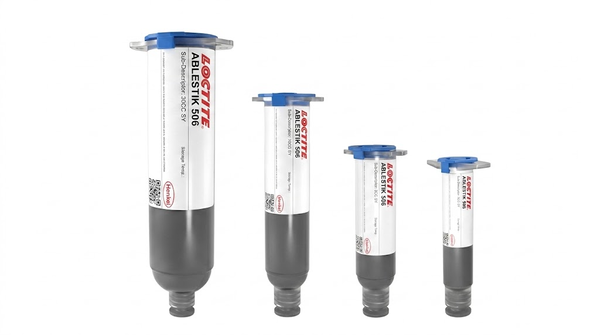
Main features
- Flexible Cured Adhesive
- 0.9 W/(m K) Thermal Conductivity
- Reworkable Bonding Material
Product Description
LOCTITE® ABLESTIK 506 is a slightly tacky, flexible epoxy adhesive film designed for bonding materials with severely mismatched coefficients of thermal expansion. The white, glass-fabric-supported film has a documented thickness of 3 mil and is suitable for assembly bonding of plastics, ceramics, and difficult-to-bond metals. Its tack can support component positioning without holding fixtures for approximately 16 hours after removal from frozen storage. Guideline heat-cure schedules include 60 minutes at 150°C, 90 minutes at 125°C, or 3 hours at 100°C.
Key features
- Flexible adhesive film: Designed for bonding adherends with severely mismatched coefficients of thermal expansion.
- Thermally conductive and electrically insulating: Typical cured properties include thermal conductivity of 0.9 W/(m·K) at 121°C and volume resistivity of 0.7 × 10¹³ ohm-cm.
- Reworkable, tacky construction: Slight tack supports component positioning, while the documented rework procedure uses heating to 125°C followed by mechanical separation.
Applications / Suitable for
- Assembly bonding of materials with severely mismatched coefficients of thermal expansion
- Bonding plastics and ceramics
- Bonding difficult-to-bond metals
- Applications requiring a flexible, reworkable adhesive film
TDS, SDS & Technical Documents
Technical Specifications
General Properties
Thermal Properties
Electrical Properties
Additional Information
As-supplied / before-processing properties
Typical construction, handling, storage, and guideline cure information for the adhesive film before final processing.
| Property | Value | Unit | Method / condition |
|---|---|---|---|
| Technology | Epoxy film | — | Flexible, slightly tacky adhesive film |
| Appearance | White film | — | As supplied |
| Carrier type | Glass fabric | — | Adhesive-film construction |
| Adhesive-film thickness | 3 | mil | Documented TDS construction |
| Density / relative density | 2.1 | — | SDS value for LOCTITE ABLESTIK 506-1-003 |
| VOC content | <0.1 | % | SDS value for LOCTITE ABLESTIK 506-1-003 |
| Work life | 24 | hours | At 25°C |
| Tack duration | Approximately 16 | hours | After removal from frozen storage |
| Shelf life | 183 | days | At -40°C; TDS property-table value |
| Recommended cure schedule | 60 | minutes | At 150°C; guideline recommendation |
| Alternative cure schedules | 90 minutes or 3 hours | — | 90 minutes at 125°C or 3 hours at 100°C; guideline recommendations |
| Cure pressure | 2–10 | psi | Continuous pressure during the cure cycle |
After-processing / final-state properties
Typical thermal, electrical, and bonded-joint properties of the cured adhesive film. Values are reference data and are not product specifications.
| Property | Value | Unit | Method / condition |
|---|---|---|---|
| Coefficient of thermal expansion — below Tg | 45 | ppm/°C | Test method and cure condition not stated |
| Coefficient of thermal expansion — above Tg | 350 | ppm/°C | Test method and cure condition not stated |
| Thermal conductivity | 0.9 | W/(m·K) | At 121°C; test method, orientation, specimen geometry, and cure condition not stated |
| Volume resistivity | 0.7 × 10¹³ | ohm-cm | Test method, specimen geometry, and cure condition not stated |
| Dielectric strength | 1,190 | V/mil | Test method, specimen thickness, conditioning, and cure condition not stated |
| Dielectric constant | 5.7 | — | At 1 kHz |
| Dissipation factor | 0.03 | — | At 1 kHz |
| Lap shear strength — aluminum to aluminum | 1,200 | psi | Tested at 25°C; surface preparation, bondline, cure condition, and test method not stated |
| Lap shear strength — gold to gold | 750 | psi | Tested at 25°C; surface preparation, bondline, cure condition, and test method not stated |