ABLESTIK 2907
Harmonization Code : 3506.10.00.00 | Prepared glues and other prepared adhesives, not elsewhere specified or included; products suitable for use as glues or adhesives, put up for retail sale as glues or adhesives, not exceeding a net weight of 1 kg
Main features
- Electrically Conductive Bonding
- Room-Temperature Adhesive Cure
- Glass-to-Plastic Epoxy Bonding
Product Description
LOCTITE® ABLESTIK 2907 is a silver-filled, two-component epoxy adhesive for electronic bonding, sealing, assembly, and repair applications requiring electrical conductivity with supporting mechanical properties. The material cures at room temperature or with heat and is supplied as a solvent-free system with medium viscosity and thixotropic flow behavior. It is used for electrical modules, printed circuitry, wave guides, flat cables, and high-frequency shields, and may be considered for heat-sensitive assemblies where hot soldering is impractical.
Key features
- Silver-filled epoxy adhesive with electrical and thermal conductivity
- Two-component system for mixed adhesive application
- Room-temperature or heat-cure processing flexibility
- Medium mixed viscosity of 6,500 mPa·s with thixotropic index of 3.5
- Typical volume resistivity as low as 3×10⁻⁴ ohm-cm after 10 minutes at 100°C
- Suitable for bonding dissimilar substrates including metals, ceramics, glass, and plastic laminates
Applications
Applications include electrical modules, printed circuitry, wave guides, flat cables, high-frequency shields, electronic bonding, sealing, assembly, and repair.
TDS, SDS & Technical Documents
Technical Specifications
Physical Properties
Thermal Properties
Electrical Properties
Additional Information
LOCTITE® ABLESTIK 2907
A two-component, silver-filled epoxy for electronic bonding, sealing, assembly, and repair. The solvent-free adhesive combines electrical and thermal conductivity with room-temperature or heat-cure processing and can be considered as a cold-solder alternative for heat-sensitive components.

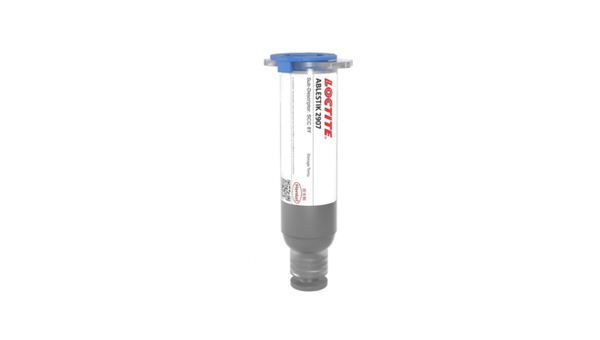
LOCTITE ABLESTIK 2907 conductive epoxy adhesive.
Uncured material properties
| Property | Typical value | Unit | Method / condition |
|---|---|---|---|
| Appearance | Silver | — | As supplied |
| Filler type | Silver | — | Product composition |
| Mixed viscosity | 6,500 | mPa·s (cP) | CP #52, 10 rpm |
| Thixotropic index | 3.5 | — | 1 rpm / 10 rpm |
| Pot life | 100 | minutes | Mixed material |
Processing and cure
Prepare clean, dry bonding surfaces, mix the two components until the color is uniform, apply the mixed adhesive, bring the parts together under contact pressure, and maintain contact through cure.

die attach dispensing process for LOCTITE ABLESTIK 2907 in a semiconductor assembly application
Store the product unopened in a dry location at the indicated optimal storage temperature of 27 °C. Do not return material removed from a container to the original package. Pre-mixed frozen material should be thawed to room temperature before use.
Cured properties and performance
Typical values are shown for the stated cure schedules and test conditions and are not product specifications.
| Property | Typical value | Unit | Method / condition |
|---|---|---|---|
| Glass transition temperature, ultimate | 50 | °C | Cured material |
| Coefficient of thermal expansion | 49 | ppm/°C | Cured material |
| Hardness | 87 | Shore D | 10 minutes at 100 °C |
| Volume resistivity at 25 °C | 3 × 10⁻⁴ | ohm·cm | Sample cured 10 minutes at 100 °C |
| Volume resistivity at 25 °C | 4 × 10⁻³ | ohm·cm | Sample cured 2 hours at 65 °C |
| Volume resistivity at 25 °C | 8 × 10⁻³ | ohm·cm | Sample cured 24 hours at 25 °C |
| Lap shear strength, aluminum to aluminum | 9.0 | N/mm² | Cured 10 minutes at 100 °C |
| Lap shear strength, aluminum to aluminum | 10 | N/mm² | Cured 2 hours at 65 °C |
| Lap shear strength, aluminum to aluminum | 8.0 | N/mm² | Cured 24 hours at 25 °C |
Loctite® Ablestik 2907 Application


Evaluate LOCTITE ABLESTIK 2907 for your electronic assembly
Contact Krayden to discuss substrate combinations, bonding or sealing requirements, cure-temperature limits, conductive-joint needs, sample requests, and comparison with related electronic assembly or soldering materials.