3M MR283FO75
Harmonization Code : 3910.00.00.90 | Silicones in Primary Forms; Others
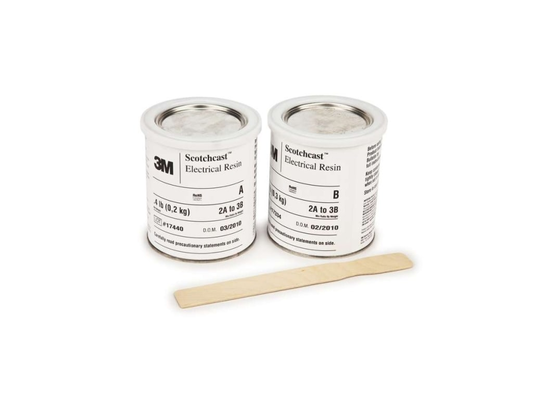
Main features
- Filled, semi-flexible epoxy system
- Low mixed viscosity
- Multiple oven-cure
Product Description
3M™ Scotchcast™ Electrical Resin MR283FO75 is a two-part, oven-curing, filled epoxy electrical resin developed for impregnating and encapsulating coils, transformers, motors and other electrical or electronic components. The semi-flexible cured resin combines Class B or Class F temperature capability with thermal-shock resistance, hydrolytic stability and electrical insulation. Its filler system is designed to reduce cure shrinkage and stress while increasing thermal conductivity and supporting dimensional stability.
Key features
- Filled, semi-flexible epoxy system: Designed to reduce shrinkage and component stress while supporting thermal and mechanical shock resistance.
- Low mixed viscosity: A typical mixed viscosity of 6,800 cP at 25°C supports impregnation and encapsulation processes.
- Multiple oven-cure schedules: Cure options range from 36–48 hours at 75°C to 3–4 hours at 120°C.
- Electrical insulation: Provides a typical dielectric strength of 372 V/mil on a 3.175 mm specimen.
- Class B or F temperature capability: Documented for temperature classes from 130°C to 155°C.
Suitable for
- Impregnation and encapsulation of coils and transformers
- Moisture-proofing and insulating motors, armatures and stators
- Insulating bus bars, toroidal cores and electrical assemblies
Relevant resource
TDS, SDS & Technical Documents
Technical Specifications
General Properties
Physical Properties
Thermal Properties
Mechanical Properties
Electrical Properties
Additional Information
3M™ Scotchcast™ Electrical Resin MR283FO75
3M™ Scotchcast™ Electrical Resin MR283FO75 is a two-part, oven-curing, filled epoxy resin for impregnating and encapsulating electrical and electronic components. Its semi-flexible cured state, thermal-shock resistance and Class B or F temperature capability support applications involving coils, transformers, motors and related assemblies.

Two-part, oven-curing electrical-grade epoxy resin for impregnation and encapsulation.
Handling and processing properties
Part A contains the filled resin component and must be thoroughly remixed before proportioning. Part A and Part B differ substantially in viscosity and specific gravity, so the documented ratio and component order must be preserved.
| Property | Part A | Part B | Test condition |
|---|---|---|---|
| Viscosity | 115,000 cP | 150 cP | Measured at 25°C |
| Specific gravity | 1.59 | 1.16 | Measured at 25°C |
| Flash point | > 150°C | > 150°C | 302°F |
| Mixed viscosity | 6,800 cP | Measured at 25°C | |
| Mixed viscosity after 18 hours | 69,000 cP | Measured at 25°C | |
Values are typical and are not minimum, maximum or guaranteed specification limits.
Preheating, mixing and de-aeration
Thorough mixing is critical because Part A contains filler that may settle during storage. Incomplete remixing or failure to scrape the container can create soft or sticky areas, reducing physical and electrical performance.
Casting, impregnation and oven cure
Preheating the resin and component lowers viscosity and can improve penetration into windings and voids. The selected cure schedule should account for the time required for the resin mass and assembly to reach the specified cure temperature.
| Cure temperature | Cure time | Processing consideration |
|---|---|---|
| 75°C | 36–48 hours | Lower-temperature cure for reduced stress and improved shock resistance |
| 95°C | 8–10 hours | Intermediate oven-cure schedule |
| 120°C | 3–4 hours | Shorter high-temperature cure schedule |
Cure time begins after the resin and assembly reach the required cure temperature. Assembly mass, oven loading and heat-transfer conditions may require additional time.
Physical and thermal properties
The cured resin combines hardness and mechanical strength with 12% elongation and increased thermal conductivity from its filled construction. Values characterize laboratory-prepared cured resin specimens.
| Property | Typical value | Test Method |
|---|---|---|
| Hardness | 80 Shore D | - |
| Cured specific gravity | 1.55 | ASTM D792 |
| Compressive strength at 10% compression | 5,500 psi/ 38 MPa | ASTM D695 |
| Ultimate tensile strength | 3,700 psi/ 25.5 MPa | MIL-I-16923G |
| Elongation at break | 12% | ASTM D638 |
| Flexural strength at 5% | 3,500 psi/ 24.1 MPa | ASTM D790 |
| Thermal conductivity | 0.463 W/(m·K) | At 29°C; ASTM D2440 |
| Glass-transition temperature | 22°C | - |
| Linear thermal expansion below Tg | 0.57 × 10⁻⁴/°C | ASTM D696 |
| Linear thermal expansion above Tg | 1.65 × 10⁻⁴/°C | ASTM D696 |
| Flame response | Self-extinguishing | MIL-I-22266C |
| Fungus resistance | Rating 2 | MIL-STD-810G Method 508.6 |
Dielectric and resistivity properties
Electrical values depend on temperature, frequency and specimen thickness. The temperature-dependent data below should not be reduced to a single universal electrical rating.
| Temperature | 100 Hz | 1 kHz |
|---|---|---|
| 23°C | 4.0 | 3.9 |
| 55°C | 4.7 | 4.5 |
| 75°C | 5.2 | 4.8 |
| 100°C | 6.4 | 5.2 |
| 125°C | 7.5 | 5.7 |
| 150°C | Not reported | 6.9 |
| Temperature | Volume resistivity |
|---|---|
| 23°C | 1.2 × 10¹⁵ Ω·cm |
| 55°C | 6.4 × 10¹² Ω·cm |
| 75°C | 1.3 × 10¹¹ Ω·cm |
| 100°C | 3.9 × 10¹⁰ Ω·cm |
| 125°C | 6.7 × 10⁹ Ω·cm |
| 150°C | 2.2 × 10⁹ Ω·cm |
Properties after 1,000 hours of thermal aging
The TDS reports weight loss, hardness change and electrical measurements after prolonged thermal aging. These laboratory results support evaluation of temperature capability but are not universal service-life predictions.
| Property | 136°C | 155°C | 180°C |
|---|---|---|---|
| Weight loss | 0.95% | 3.43% | 4.56% |
| Hardness change | 4 | 6 | 8 |
| Dissipation factor at 100 Hz | 0.0186 | 0.0151 | 0.0153 |
| Dielectric constant at 100 Hz | 3.93 | 4.15 | 4.28 |
The TDS identifies the product temperature class as 130–155°C.
Electrical impregnation and encapsulation applications
MR283FO75 is intended for electrical insulation processes where thermal conductivity, shock resistance, moisture protection and penetration into windings or voids are important considerations.

Coils and transformers
The mixed resin can be heated and vacuum processed to improve penetration into coil windings and internal voids.

Motors, armatures and stators
The resin is documented for moisture-proofing and insulating motor components requiring thermal and mechanical shock resistance.

Bus bars and toroidal cores
The cured epoxy provides electrical insulation and environmental protection for supported electrical assemblies.
3M Scotchcast OEM resin selection guide
This supplier guide provides broader information about Scotchcast electrical liquid resins, including cure type, filler selection, flexibility, temperature class, processing considerations and comparative product data.
Tough, Reliable Protection: 3M™ Scotchcast™ OEM Resins
Selection and application guidance for electrical-grade epoxy and polyurethane liquid resins used to insulate and protect electrical and electronic assemblies.
View the 3M Scotchcast resin guideEvaluate 3M™ Scotchcast™ MR283FO75 for your electrical insulation process
Contact Krayden to review mixing, vacuum de-aeration, impregnation, oven capacity, cure scheduling, temperature-class requirements and application-specific electrical, thermal or mechanical testing.